Managing Algae in Planted Tanks
Green spot, black beard, hair algae, diatoms. Every algae type has a cause and a cure. Understand the imbalance before reaching for chemicals.
Photo by Kayven on Unsplash
In this guide
Algae is not an infection. It is feedback.
Every planted tank has algae spores in it, permanently, brought in on plants, on fish, in the water, on your hands. They are always there and always waiting. What decides whether they take over is whether conditions favour them over your plants.
Healthy, actively growing plants outcompete algae. That is the entire mechanism. So when algae appears, the useful question is never "what kills this" but "what are my plants not getting."
The diagnostic shortcut

Before going type by type, here is the order in which problems actually occur, based on how often each turns out to be the culprit:
- Too much light for the CO₂ and nutrients available. By a wide margin the most common cause.
- CO₂ that fluctuates, or is delivered unevenly across the tank.
- Poor flow, leaving dead spots where organics settle and nothing circulates.
- Ammonia, from an immature filter, overfeeding, a dead fish, or disturbed substrate. Ammonia is a direct trigger for algae spore germination.
- Nutrient deficiency, usually one specific element rather than "not enough fertiliser."
Notice that "not enough fertiliser" is fifth. The instinct when algae appears is to cut nutrients, because algae must be eating them. This is backwards more often than not. Starving nutrients starves your plants first, plants stop growing, and algae inherits everything.
Growth is capped by CO₂. Everything above that line is surplus, and surplus is what algae takes.
Algae is not an infection. It is feedback.
Identify what you have
Diatoms (brown dust)
Brown, soft, coats glass and leaves and substrate in a fine film. Wipes off easily.
Almost exclusively a new tank problem, appearing in the first two to eight weeks. Silicates leaching from new substrate and an immature biofilter are the drivers.
What to do: nothing dramatic. Wipe the glass, keep up water changes, wait. It resolves on its own as the tank matures. Otocinclus eat it enthusiastically, though a brand new tank is a bad home for them since they need biofilm to fall back on.
If diatoms show up in an established tank, look for a recent disruption: new substrate, a filter clean that reset your bacteria, a big stocking change.
Green spot algae (GSA)
Small, hard, circular green dots. Mostly on the glass, and on slow-growing old leaves like anubias and buce. You need a blade or a magnetic scraper to shift it, which distinguishes it from soft green film.
Cause: low phosphate, combined with high light. This surprises people because phosphate has a reputation as an algae fuel. In a plant-heavy tank, phosphate limitation is a real thing and GSA is its calling card.
What to do: raise phosphate dosing. Target somewhere in the 1 to 2 ppm range for a high-tech tank. Existing spots will not disappear, so scrape them off and judge by whether new ones appear. Nerite snails handle GSA on glass better than anything else, and unlike other snails they will not breed in freshwater.
Green dust algae (GDA)
Different from GSA despite the similar name. It is a soft green film that coats the glass in a uniform layer, wipes off easily, and comes straight back within a couple of days.
What to do: counterintuitively, stop wiping it. GDA has a life cycle. If you leave it alone for around three weeks, it matures, releases zoospores, and sloughs off the glass by itself. Wiping it every few days resets the cycle indefinitely and you can fight it for months. Leave the glass alone, wipe once at the end, do a large water change and vacuum.
This one is genuinely hard to follow because you have to look at a green tank for three weeks.
Hair and thread algae
Long green strands, wrapping around plant stems and hardscape. Fine and soft.
Cause: usually an excess of light relative to CO₂, often kicked off by an ammonia event. It also spikes after a big trim, when you have removed a large share of your plant mass and the remaining plants cannot use everything available.
What to do: manual removal is genuinely effective here. Wrap it around a toothbrush or a chopstick and twist. It comes away in clumps. Then reduce photoperiod, check CO₂ distribution, and hold off adding light back for a few weeks.
Amano shrimp are the best biological control in the hobby for hair algae. A group of ten in a 60 litre tank will strip it. Feed them lightly or they lose interest in working.
Black beard algae (BBA)
Dark grey to black tufts, an almost bristly texture, growing on hardscape edges, filter intakes, and leaf margins. It is actually a red algae, and it turns red or pink when it dies, which is how you confirm a treatment worked.
Cause: unstable or insufficient CO₂, poor flow, and accumulated organics. It concentrates at high-flow points such as filter outlets and intake strainers, which sometimes confuses people into thinking flow causes it. Flow does not cause it, flow delivers spores to a surface where the conditions suit them.
What to do: this is the one where treating symptoms is justified alongside fixing causes, because BBA is stubborn.
- Fix CO₂ first. Stable, consistent, distributed. Check the drop checker is green at lights-on, not four hours later.
- Spot treat with 3% hydrogen peroxide or liquid carbon. Lower the water level so the affected area is exposed, apply with a syringe directly onto the tufts, leave for a minute or two, then refill and run the filter. The BBA should turn pink or white over the next few days.
- Whole-tank peroxide dosing is possible at roughly 1 ml per 4 litres, but be conservative and watch shrimp closely. Some shrimp keepers will not do it at all, and I understand why.
- Boil or bleach-dip affected hardscape if it is removable. A 1:20 bleach solution for two minutes, then a very thorough rinse and dechlorinator soak.
Siamese algae eaters eat BBA when young. Once they are large they get lazy and prefer flake food, so they are a temporary tool, not a solution.
Staghorn algae
Grey-green, branching like antlers, tough texture. Very similar in cause and treatment to BBA. Same approach: CO₂ stability, flow, spot dosing.
Green water
The whole tank turns pea soup green. Free-floating single-celled algae, not attached to anything, so scrubbing does nothing.
Cause: an ammonia spike, almost always. New tank, disturbed substrate, overfeeding, or a filter failure.
What to do: a UV steriliser is the reliable fix and it works within two to three days. If you do not have one, a full three day blackout with the tank wrapped in bin liners also works, but it is slower and less certain. Diatom filters clear it mechanically.
Do not do large water changes to fix it. You are removing green water and leaving behind the conditions that made it, and the bloom returns. Fix the ammonia source.
Cyanobacteria (blue-green algae)
Not algae at all. A slimy sheet, usually dark green or blue-green, sometimes red, that peels off in one piece and smells distinctly musty and unpleasant. That smell is diagnostic on its own.
Cause: low nitrate, poor flow, and organic buildup, typically in a dead spot in the substrate near the front glass.
What to do:
- Siphon out every bit you can see, physically.
- Raise nitrate. Yes, dose more nitrate. Cyano thrives where nitrate is near zero because it can fix nitrogen from the atmosphere and your plants cannot.
- Increase flow to the affected area.
- A three day blackout works well on cyano specifically.
- Erythromycin will clear it in 48 hours because cyano is a bacterium. It will also hit your biofilter, so test ammonia daily afterward. I treat this as a last resort rather than a first move.
Cladophora
Coarse, tough, green, branching, and it has a distinctive musty smell when you pull it out. Often arrives on Marimo moss balls, since Marimo is a form of Cladophora.
Genuinely difficult. It resists most treatments and grows tangled into plant tissue. Manual removal is the main tool, and it is patient work. Spot dosing peroxide helps. Prevention is much easier than cure: quarantine new plants and avoid Marimo balls in a scaped tank.

The structural fixes
Once you have identified the type, most solutions come back to the same four levers.
Light. Lower intensity beats shorter duration for algae control, though both help. A 6 to 8 hour photoperiod is plenty. Fourteen hours of light does not make plants grow more, it just extends the window in which algae can exploit whatever your plants cannot use. If your fixture has no dimmer, raise it higher above the tank or add layers of window screen mesh, which is a genuinely effective and very cheap trick.
CO₂. In a high-tech tank, stability matters more than the absolute number. Get to your target concentration by lights-on, not two hours later, which usually means starting the solenoid an hour or two before the lights. A drop checker with 4 dKH reference solution should be green, not blue, and not yellow. Yellow means you are risking your fish.
- Lights 13:00 to 20:00
- CO₂ from 11:30
- Drop checker green by lights on
Low-tech tanks are not exempt. They just need proportionally less light, and they need you to accept slower growth. The failure mode for a low-tech tank is almost always too much light.
Flow. Aim for roughly ten times tank volume per hour in filter turnover for a planted tank, and more importantly, make sure the current actually reaches the back corners and the substrate line. Put a bit of plant clipping in the water and watch where it goes. Anywhere it settles and stays is a future cyano site.
Nutrients. Pick a dosing method and stay consistent rather than adjusting weekly based on how the tank looks. Estimative Index dosing deliberately supplies an excess of everything and relies on weekly 50% water changes to reset. Lean dosing supplies close to what plants consume. Both work. Switching between them every fortnight does not.
Cleanup crew, realistically
- Amano shrimp: the best general algae eaters available. Hair algae, thread algae, general detritus. Keep them slightly hungry.
- Nerite snails: unbeatable on green spot algae on glass. Lay white eggs everywhere that do not hatch in freshwater and are somewhat annoying to remove.
- Otocinclus: diatoms and soft green film. Fragile, need a mature tank, and must be kept in groups of six or more.
- Siamese algae eaters: eat BBA while young. Grow to 15 cm and get lazy.
- Nerite and Amano together cover most of what a planted tank produces.
None of them fix causes. A cleanup crew in a tank with bad CO₂ is a crew fighting a losing battle. Treat them as maintenance staff, not as a solution.
What to do when things are already bad
If a tank is badly overrun, do not try to fix everything at once. In order:
- Manually remove as much algae as physically possible. Scrub hardscape, siphon, trim badly affected leaves off entirely rather than trying to clean them.
- Large water change, 50%.
- Cut the photoperiod to 6 hours and drop intensity.
- Fix flow and check CO₂ distribution.
- Keep dosing nutrients. Do not starve the tank.
- Wait three weeks without changing anything else.
The waiting is the hard part. Every change you make resets the clock on knowing whether the previous change worked. Most people fail at algae control not because they picked the wrong fix, but because they tried four fixes in ten days and learned nothing from any of them.
- Remove as much algae as you physically can
- Change half the water
- Cut the light to six hours and lower it
- Fix flow and check where the CO₂ goes
- Keep dosing nutrients
Then wait. Change nothing else.
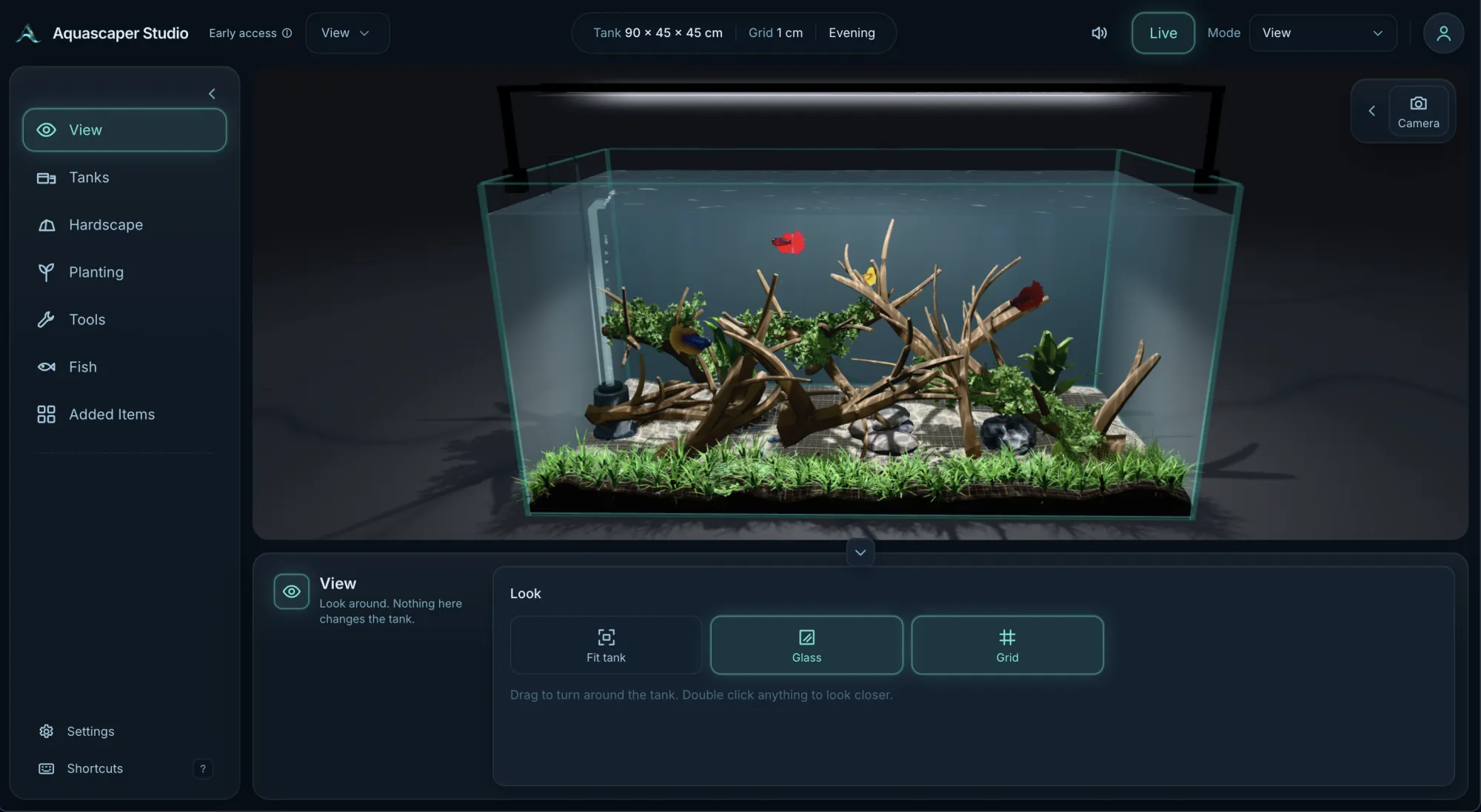
Plan a layout that lets water move.
Anywhere current does not reach is a future cyano site. Leave open channels in the hardscape so flow gets to the back corners.
Open the builder