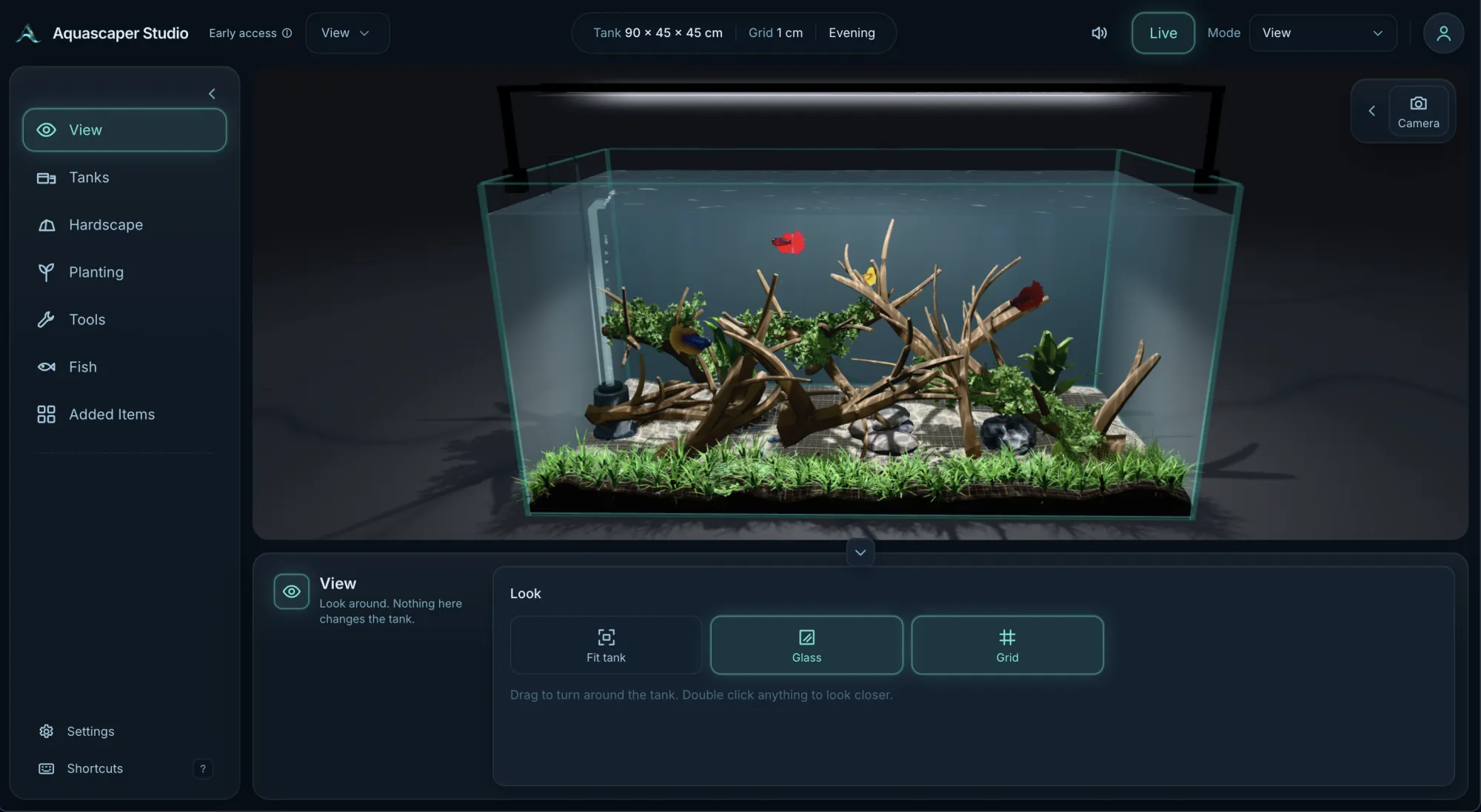
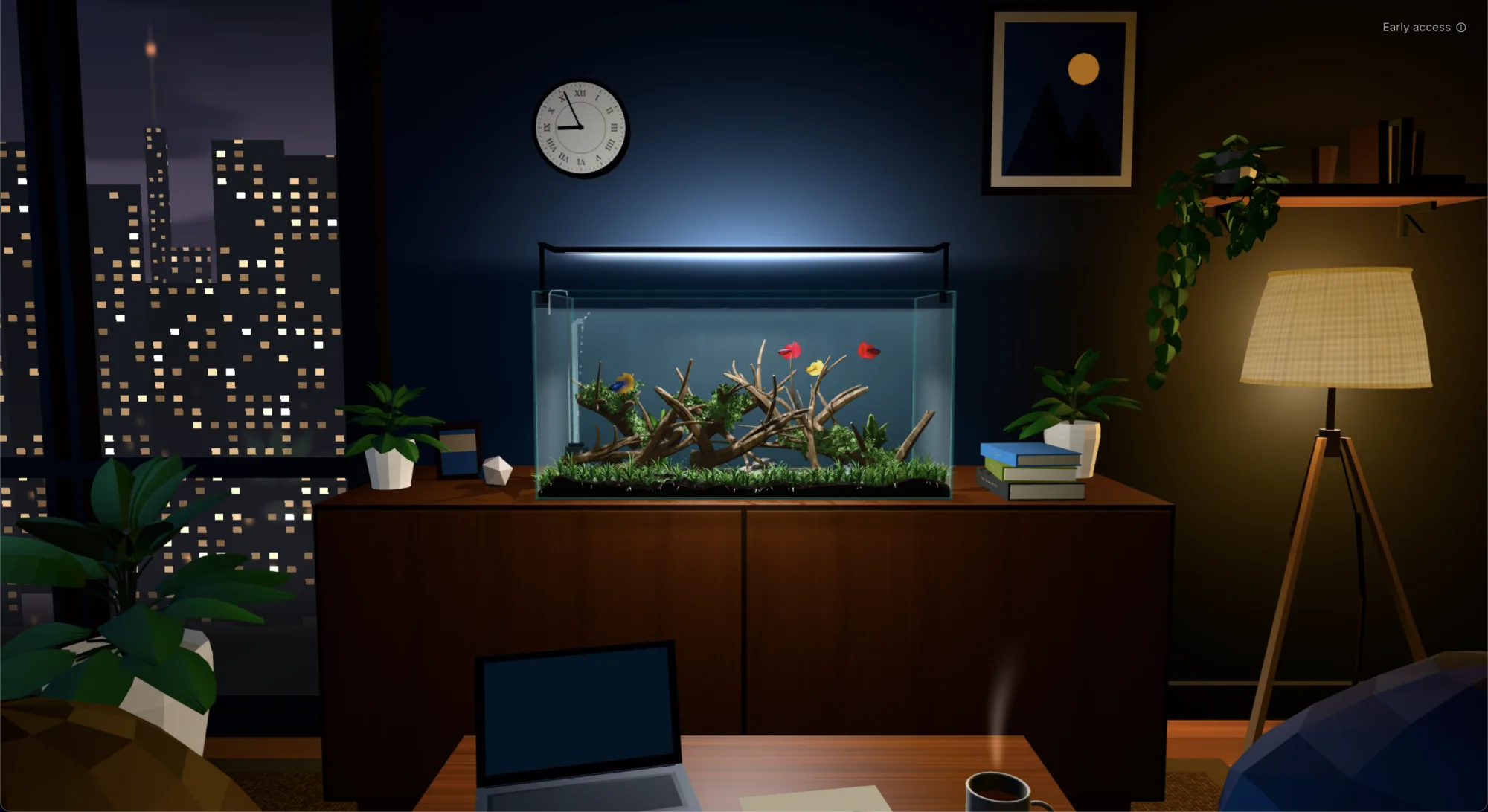
Hardscape Before Everything
Rocks and wood define the skeleton of any aquascape. Learn the odd-number rule, the golden ratio, and why you should arrange hardscape in a dry tank first.
Photo by The ILP on Unsplash
In this guide
Plants forgive you. Hardscape does not.
You can swap a foreground carpet, move a stem bush, change your entire plant list six months in. But once there is substrate packed around three stones and a plant carpet grown over the base, moving the main rock two centimetres to the left means tearing the tank apart.
So the rocks and wood get decided first, in a dry tank, with nothing else in the way. This is the single habit that separates scapes that look composed from scapes that look like a pile of stuff.
Do it dry, and take photos
Empty tank. No substrate, or a rough layer of cheap base gravel you do not mind rearranging. Put the stones in. Take them out. Put them back differently. Do this for an hour, or an evening, or across three days.
Then take a photo on your phone from where you will actually sit when you look at the tank. Not from above, not pressed against the glass. From the sofa.
The photo will show you things your eye will not. Two stones that felt distinct in the room read as one blob in the image. A piece of wood that looked dramatic turns out to point directly at the corner and lead your eye out of the tank. Flattening a scene to two dimensions is exactly what the viewer's brain does anyway, so the camera is telling you the truth.
I have thrown out arrangements I was proud of after seeing them on a phone screen. That is the point of the exercise.
Plants forgive you. Hardscape does not.
The rules that are worth knowing
Odd numbers
Three stones, five stones, seven. Even numbers pair up visually and read as symmetrical, and symmetry in nature looks manufactured. With three, one dominates and the other two support. With four, your eye keeps trying to split them two and two.
This applies to groups, not to every individual piece. Nobody is counting the pebbles.
Three stones
Four stones
The main stone rules everything
In traditional Japanese arrangement the dominant stone is called the oyaishi. Pick it first, and pick it honestly: it should be clearly the largest and most interesting piece you own. Everything else is subordinate.
Place it off centre. Roughly a third of the way in from one side, occupying something like two thirds of the tank height, tilted rather than sitting flat. A vertical stone standing straight up looks planted by a person. A stone leaning slightly, as if it settled that way over years, looks found.
Then place the second largest stone as a counterweight on the other side of the tank, smaller and lower. Then the third, smaller again, filling in the rhythm.
The golden ratio, or just the rule of thirds
Divide the tank width into thirds and put your focal point near one of the dividing lines. If you want to be precise about it, 0.618 of the width from one edge. If you want to be practical about it, "clearly off centre, but not right at the edge" gets you there.
Centre placement is the most common beginner mistake and the easiest to fix. Move it. It will feel wrong for about a day.
Grain direction
Stones have visible strata, cracks, and texture lines. Turn them so those lines run in a consistent direction across the whole layout, usually angled slightly rather than dead horizontal. When the grain of one stone runs against everything else, it reads as an intruder even if the shape is perfect.
This is a small thing that makes a large difference and almost nobody mentions it.
The three layout shapes
Nearly every scape resolves to one of these, and picking one before you start saves you an hour of aimless rearranging.
Concave. Higher on both sides, dipping in the middle. Creates a valley or a path leading into the distance. Very forgiving, works in almost any tank width, and the open centre is where you put a shoal of fish so they have somewhere to swim in view.
Convex. Mass in the middle, falling away at both edges. An island. Reads well from all sides, which makes it the right choice for a tank you can walk around. Harder to pull off in a short tank because the mound has nowhere to fall away to.
Triangular. Mass on one side, sloping down to open space on the other. The easiest layout to make look good and the most common in nano tanks. It also handles equipment placement well because you can hide the filter intake behind the high side.
Concave
High at both sides, open in the middle. Forgiving, and the gap is where the shoal swims.
Convex
An island in the middle falling away to both edges. Best for a tank you can walk around.
Triangular
Mass on one side sloping to open space. The easiest to make look good, and it hides the filter.
Depth is manufactured, not real
Your tank is 45 cm front to back at most. Everything that makes it feel like a landscape is an illusion, and the illusions are consistent:
- Slope the substrate upward toward the back. Two centimetres at the front glass, six or seven at the back. Steeper than you think looks right in an empty tank, because plants will fill in and soften it.
- Use finer grain at the back and coarser at the front. Detail resolves in the foreground and blurs at distance in real landscapes, so this reads as depth automatically.
- Smaller stones behind, larger in front. Same principle as a film set.
- Keep the back corners darker and busier, the front open. An open foreground gives the eye somewhere to rest and makes everything behind it look further away.
Substrate slopes collapse over time. Support the back with a low retaining structure: a strip of rock, a piece of filter sponge cut to shape, plastic mesh, a length of driftwood. Anything invisible once planted.
Negative space is not wasted space
The gap between two stones is part of the composition. Beginners tend to fill every centimetre because empty glass feels like an unfinished job. It is not. A single open sand channel running from the front glass into a gap in the hardscape does more for a scape than three extra rocks.
If your layout feels cluttered, remove something rather than adding something to balance it. This is almost always the correct move.
Choosing material
Stone
Seiryu is the classic. Sharp, grey, dramatic veining. It is also calcareous and will raise your KH and GH over time, which matters if you plan on Caridina shrimp or soft water fish. Test any unknown stone with a drop of vinegar: fizzing means carbonates, which means buffering.
Dragon stone (Ohko) is inert, porous, and full of holes and texture. Very forgiving to arrange because almost any face looks interesting. It is soft and crumbly, so handle it gently and expect fine dust when you first rinse it.
Lava rock is cheap, inert, extremely light, and excellent as hidden structure under other stone or as a base for substrate slopes. Not usually the star of the show.
Buy more than you need. Aquascapers who compete buy fifteen kilos to use four. You cannot compose from three stones if none of them is the right shape.

Wood
Spider wood and manzanita have branching, twiggy forms and are the go-to for tree-style scapes. They float aggressively when dry and often need weeks of soaking or temporary weighting.
Mopani is dense, dark, heavy, and usually sinks straight away. It leaches heavy tannins for months and will tint your water tea brown unless you boil it or run purigen.
Redmoor and azalea sit somewhere between the two.
Tannins are not harmful. Many fish prefer the softer, slightly acidic water they produce. Whether you want the colour is an aesthetic decision, not a health one. Boiling speeds up leaching and helps waterlogging at the same time.

Combining the two
Wood on stone almost always beats wood next to stone. Wedge branches into rock crevices so they look like they grew there or washed in and lodged. Loose wood lying on the substrate near a rock reads as two separate objects sharing a room.
Where people go wrong
- Buying hardscape after buying plants. Plan the skeleton, then choose plants that suit it. The other way round leads to a plant list with nowhere to go.
- Symmetry. If you can fold the tank down the middle and the halves match, start again.
- Everything the same size. Contrast in scale is what makes a group of stones read as a formation instead of a collection.
- Ignoring equipment. Decide where the filter intake, outflow, heater, and CO₂ diffuser go while the tank is still dry. Building a beautiful layout and then discovering the only place for the heater is dead centre is a genuinely miserable experience.
- Committing too early. The dry scape stage is free. Rearranging a planted tank is not.
A workable sequence
- Empty tank, dry, on its final stand in its final position.
- Lay out all your stone and wood on the floor. See what you have.
- Pick the main piece.
- Build a rough layout in one of the three shapes. Photograph it.
- Change one thing. Photograph again. Compare.
- Repeat until a version stops bothering you.
- Only then add substrate, slope it, lock the hardscape in, and plant.
Spend a week on step six if you need to. The tank will be there for years.
Rearranging stone costs nothing on a screen.
Try all three layout shapes and move the main stone until a version stops bothering you, before a single rock goes into the glass.
Open the builder