CO₂ for Planted Tanks
Pressurised CO₂ can transform plant growth, but unstable delivery causes more trouble than a modest target. Set up, measure, and tune it safely.
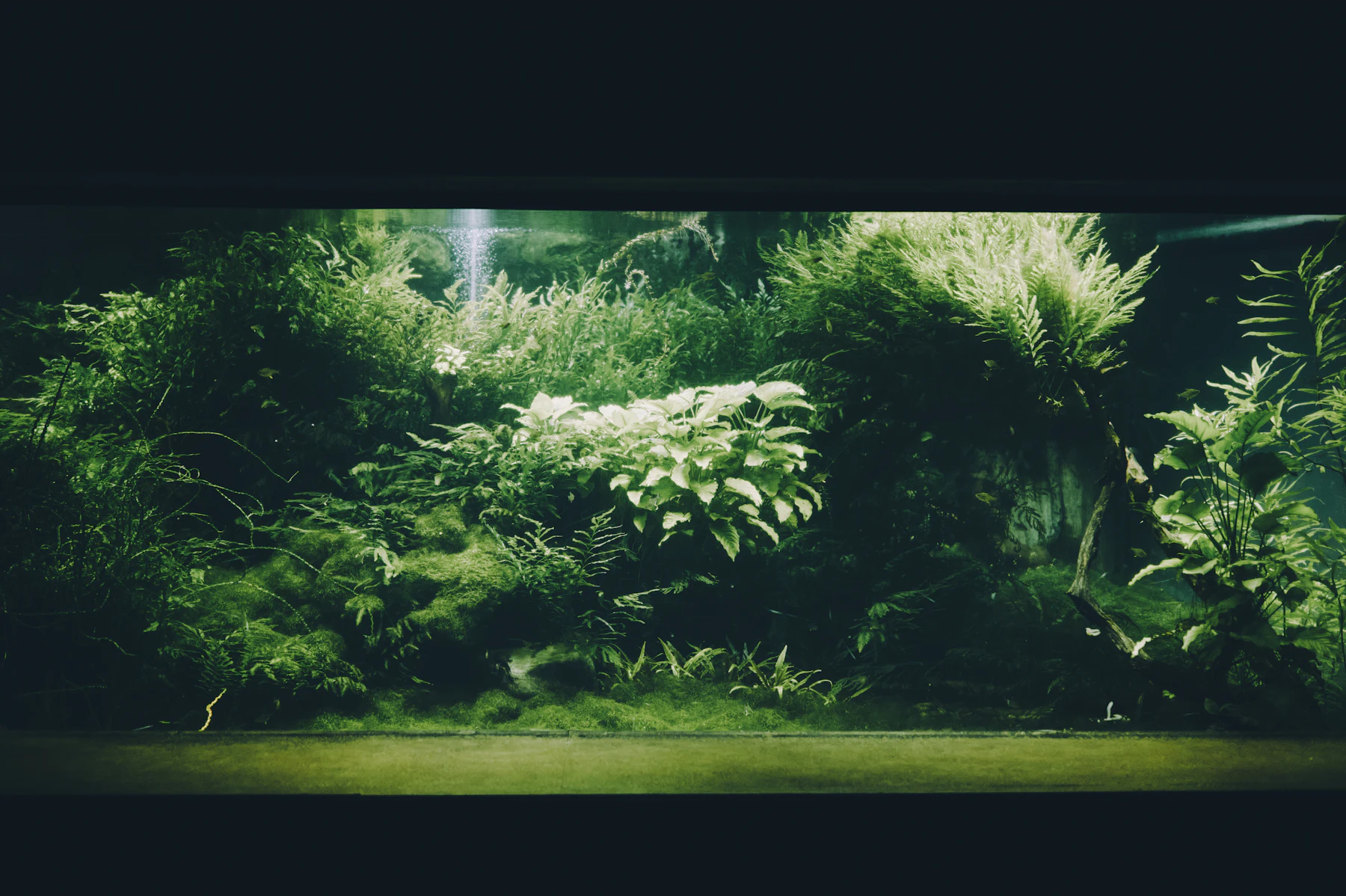
Photo by Arthur Colas on Unsplash
In this guide
- Why underwater plants run short of carbon
- Pressurised CO₂ is the system worth buying
- Diffusion is a distribution problem
- Start before the lights, stop before they go out
- Measure trends, not bubble counts
- Surface agitation is not the enemy
- Stability matters more than chasing a maximum
- How to tune a new system
- CO₂ and light have to agree
- A practical daily setup
CO₂ is not fertiliser in a bottle. It is one of the raw materials plants use to build themselves.
A planted aquarium can run without injected CO₂, but injection removes one of the largest limits on underwater growth. The trade is simple: plants gain speed and choice, while you gain another system that must be stable.
Why underwater plants run short of carbon
Terrestrial plants live in an atmosphere containing readily available CO₂. Submerged plants have a harder job because gases diffuse through water far more slowly than through air.
Aquarium plants use carbon during photosynthesis. When light is strong enough and nutrients are available, carbon availability often becomes the bottleneck. Injecting gaseous CO₂ raises the dissolved concentration and lets plants use the light and nutrients more effectively.
The visible difference can be dramatic: faster growth, denser carpets, healthier new leaves, and a wider range of species that will grow well submerged.
This does not mean every planted aquarium needs injection.
Anubias, Java fern, many Cryptocoryne, mosses, and other slower species can make excellent low-tech tanks. Their growth is slower, which also means less pruning and a smaller demand for fertiliser.
The mistake is building a high-light aquarium full of demanding plants and expecting low-tech carbon availability to keep up.
Light sets the accelerator. CO₂ is part of the engine.
Light sets the accelerator. CO₂ is part of the engine.
Pressurised CO₂ is the system worth buying
For a serious planted tank, pressurised CO₂ is the predictable option.
The basic chain is:
cylinder → regulator → solenoid → needle valve → check valve → tubing → diffuser or reactor
The regulator reduces cylinder pressure to a usable working pressure. The needle valve gives fine control over flow. The solenoid lets a timer switch gas on and off. The check valve stops aquarium water travelling backwards into equipment.
- CylinderStores the gas at high pressure
- RegulatorDrops it to a usable working pressure
- SolenoidLets a timer switch the gas on and off
- Needle valveSets the rate, finely
- Check valveStops tank water travelling back up the line
- DiffuserPuts the gas into moving water
A bubble counter is useful for repeatability, but bubbles per second are not a concentration measurement. Bubble size varies between counters, pressure changes behaviour, and two aquariums can require very different injection rates.
Disposable cartridges work for small tanks but become expensive quickly. DIY yeast and citric-acid systems can produce CO₂, but output and pressure are less consistent. They are interesting projects. Stability is the part plants and fish care about.
Buy a proper regulator before buying a decorative glass bubble counter. The regulator is doing the dangerous and useful work.
CO₂ cylinders are high-pressure vessels. Keep the cylinder upright and secured, use components rated for the gas and pressure involved, and never modify valves or regulators. Have cylinders filled and inspected through an appropriate supplier.
Diffusion is a distribution problem
Getting gas out of the cylinder is only half the job. The CO₂ has to dissolve and reach the plants.
An in-tank ceramic diffuser produces fine bubbles that dissolve as they travel. It is simple and visible, and works well in many small to medium aquariums.
An inline diffuser sits on the filter return line. It removes equipment from the display and can distribute mist through the outlet, but it needs suitable tubing, pressure, and filter flow.
A reactor aims to dissolve most of the gas before water returns to the aquarium. It can be extremely efficient and visually clean, particularly on larger tanks, but adds plumbing and can reduce flow if badly sized.
Whatever method you use, placement matters.
Put dissolved CO₂ into moving water and make sure that water reaches the whole planted area. A beautiful diffuser producing a cloud in one corner while the opposite corner barely moves is mostly producing a beautiful cloud.
Watch fine debris or tiny bubbles in the current. If circulation never reaches a dense stem group, CO₂ delivery probably does not either.
Better distribution often fixes a weak area without increasing the injection rate.
Start before the lights, stop before they go out
Plants need elevated CO₂ when the lights are on. Waiting until lights-on to begin injection means the first part of the photoperiod is spent while dissolved CO₂ is still climbing.
A common starting strategy is to switch injection on roughly 1 to 2 hours before the lights and switch it off roughly 1 hour before lights-out. The exact timing depends on diffusion efficiency, circulation, surface agitation, tank volume, and the injection rate.
Do not worship the timer setting. Measure what the water actually does.
The goal is for CO₂ to be near its intended level when the photoperiod begins, then remain reasonably stable while plants are photosynthesising.
At night, plants do not need injected CO₂. Fish, plants, and microorganisms continue respiring and consuming oxygen, so running injection through the dark period gives you risk without useful plant growth.
A solenoid on the same schedule every day is one of the least glamorous and most valuable parts of the system.
- CO₂ on1 to 2 hours early
- Lights onlevel already up
- CO₂ offan hour early
- Lights offnone at night
Measure trends, not bubble counts
There are several ways to judge CO₂, and none should replace watching the animals.
A drop checker contains indicator solution isolated from aquarium water by an air gap. CO₂ equilibrates into that solution and changes its colour. It is convenient, but slow. The displayed colour can lag the aquarium by around 1 hour, and a green checker is not a precise promise of 30 mg/L CO₂.
Treat it as a broad indicator.
A more useful tuning method is the pH drop caused by dissolved CO₂. Take aquarium water and allow it to degas thoroughly in contact with air, then measure its pH. Compare that with aquarium pH during the period of stable CO₂ injection.
In water with ordinary carbonate hardness, a drop of around 1.0 pH unit from a properly degassed baseline is commonly used as a rough indicator of substantial CO₂ enrichment, often around the 30 mg/L region. It is still an estimate, not a licence to ignore livestock.
Do not use a generic pH/KH/CO₂ chart blindly when the aquarium contains aquasoil, acids, buffers, or other substances affecting pH and alkalinity. Those charts assume a simpler carbonate system than many planted tanks actually have.
The most important measurement remains fish behaviour.
Rapid breathing, surface gathering, loss of balance, or unusual lethargy during injection are reasons to stop CO₂ immediately and increase aeration and surface agitation. Do not wait for a drop checker to change colour.
Surface agitation is not the enemy
A common planted-tank belief says the surface must be almost motionless because agitation wastes CO₂.
That is a poor trade.
Gas exchange supplies oxygen and prevents excessive accumulation of dissolved gases. Healthy fish, aerobic microorganisms, and plant roots all benefit from adequate oxygen. Good surface movement also makes the system more forgiving when CO₂ is being injected.
Yes, stronger agitation can increase CO₂ loss to the room. The answer is to use an appropriate injection rate, not to suffocate the surface.
Aim for a visible gentle ripple rather than violent splashing or a sealed-looking surface.
A tank with efficient gas exchange may consume more bottled CO₂ than a stagnant one. Bottled gas is cheaper than livestock.
At night, some high-tech aquariums use extra aeration after CO₂ shuts off. This is especially useful in heavily stocked tanks or systems with limited surface movement.
Stability matters more than chasing a maximum
Plants respond badly to inconsistent carbon availability, and algae is very good at exploiting unstable conditions.
The usual problems, in order, are:
- CO₂ reaches the tank too late. Injection starts at lights-on and concentration spends hours climbing.
- Distribution is uneven. One area receives enriched water while another sits behind hardscape or dense growth.
- The injection rate changes. A poor regulator, nearly empty cylinder, blocked diffuser, or casual needle-valve adjustment moves the target.
- Light is too strong for the CO₂ system. The plants are being asked to photosynthesise faster than carbon can be supplied consistently.
- The hobbyist keeps changing everything. Yesterday more gas, today more light, tomorrow less fertiliser. The aquarium never gets a stable week to answer.
If plants are growing well at moderate light and the aquarium is clean, there is no obligation to push CO₂ higher.
High saturation is useful for demanding aquascapes, but it narrows the safety margin. The last few percent of plant performance is expensive in attention.
How to tune a new system
Start conservatively.
Set the diffuser and filter flow first. Make sure the aquarium has reasonable surface movement. Set a modest photoperiod and do not begin with the light at maximum intensity.
Then increase CO₂ gradually over several days while observing pH response, plant growth, and livestock behaviour. Make one meaningful adjustment at a time.
If using a pH method, measure at consistent times. A reading from properly degassed tank water and readings around lights-on and later in the photoperiod tell you much more than random measurements across the week.
If the target level is reached too late, first consider starting injection earlier or improving dissolution and flow. Do not automatically turn the needle valve dramatically higher.
If one corner grows poorly or develops algae while the rest of the aquarium thrives, investigate circulation before increasing gas for the entire tank.
Clean diffusers when output becomes coarse or restricted. Check tubing and connections for leaks. A soap solution can reveal leaks on external gas fittings, but keep soap away from aquarium water and rinse tools before they go anywhere near the tank.
When a cylinder is changed, watch the system closely. Do not assume the previous needle-valve position guarantees identical behaviour.
CO₂ and light have to agree
CO₂ injection does not require extreme lighting.
In fact, moderate light with stable CO₂ is one of the easiest ways to grow a wide range of plants cleanly. Carbon enrichment improves growth even when light is not being pushed hard.
The reverse combination is much less forgiving: intense light with weak or inconsistent CO₂.
If algae appears after increasing light, resist the urge to immediately add more fertiliser, more CO₂, and a new algae treatment. Return the light to the previous level and stabilise the system first.
Plants can only use resources in combination. Giving them much more of one input does not compensate neatly for a shortage of another.
This is also why a low-tech aquarium should usually run less light than a high-tech one. It is not punishment for refusing to buy a cylinder. It is matching demand to supply.
A practical daily setup
For a new pressurised system:
- Secure the cylinder upright and install a suitable regulator, solenoid, needle valve, check valve, and diffuser or reactor.
- Confirm the aquarium has good circulation and gentle surface agitation.
- Put the light and solenoid on timers.
- Begin with CO₂ switching on about 1 to 2 hours before lights-on and off about 1 hour before lights-out.
- Start with a conservative injection rate.
- Observe livestock throughout the photoperiod and stop injection immediately if they show respiratory distress.
- Track pH at consistent times, preferably against a properly degassed baseline.
- Adjust slowly over several days, changing one variable at a time.
- Improve flow or diffusion before assuming the aquarium simply needs more gas.
- Once plants are growing well, leave the settings alone long enough to judge them.
Do not chase a particular bubble count. Do not chase the exact shade of lime green in a glass bulb.
The best CO₂ system is boring by the second week.
That means it is doing its job.
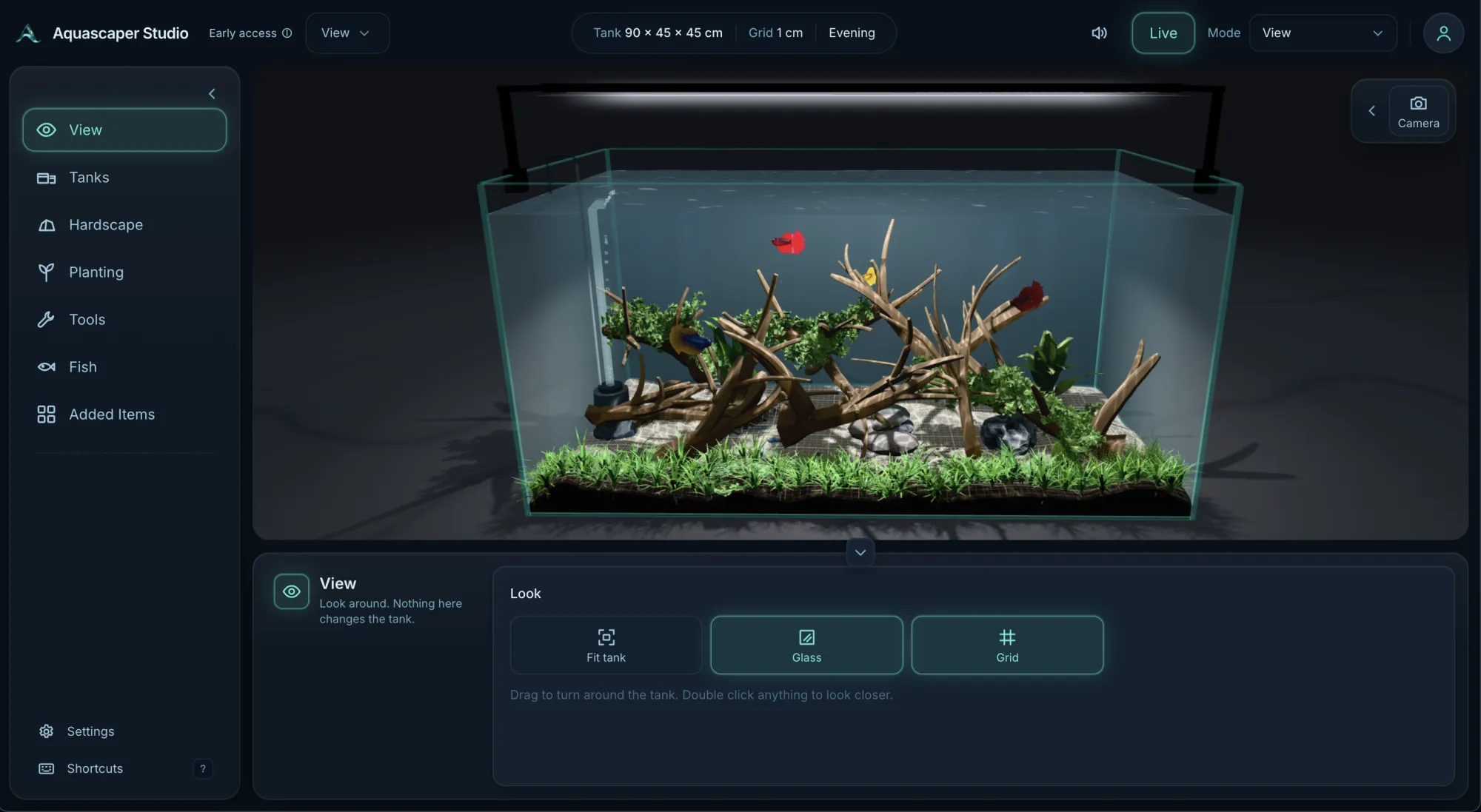
Design the layout around the flow.
Plan where the diffuser, the outflow and the densest planting sit, so enriched water reaches the back corners instead of one bright cloud.
Open the builder