Reef Tank Chemistry 101
Alkalinity, calcium, and magnesium form the triad of reef chemistry. SPS coral consume these elements rapidly. Learn to balance the big three.
Photo by David Clode on Unsplash
In this guide
A reef tank is a chemistry problem wearing a nice aesthetic.
In freshwater, water changes and a filter cover most of what you need. In a reef, corals are actively pulling minerals out of the water to build skeleton, twenty four hours a day, and the faster they grow the faster they strip the tank. Your job is to put those minerals back at the same rate they leave, without ever moving the numbers sharply.
That last part matters more than anything else in this guide. Stability beats optimal. A tank held steadily at 7.5 dKH will outperform a tank swinging between 8 and 10 every week, every time.
The parameters that matter, and their ranges
| Parameter | Working range | Range on scale | Notes |
|---|---|---|---|
| Salinity | 35 ppt / 1.026 sg | Match your water change water exactly | |
| Temperature | 25 to 27°C | Stability over exact value | |
| Alkalinity | 7 to 11 dKH | Pick a number and hold it | |
| Calcium | 400 to 450 ppm | Follows alkalinity | |
| Magnesium | 1250 to 1350 ppm | The enabler for the other two | |
| Nitrate | 2 to 10 ppm | Zero is a problem, not a goal | |
| Phosphate | 0.03 to 0.10 ppm | Same | |
| pH | 7.9 to 8.4 | Largely a symptom, not a lever |
If you take one thing from that table, take this: nitrate and phosphate should not be zero. The old reefing wisdom of driving nutrients to undetectable was wrong, and tanks run that way go pale, get dinoflagellates, and lose colour. Corals need nitrogen and phosphorus. Their symbiotic zooxanthellae need them more.
Why the triad exists

Coral skeleton is calcium carbonate. To build it, a coral takes calcium ions and carbonate ions out of the water and lays them down.
That means every millimetre of new SPS growth removes calcium and alkalinity from your tank simultaneously, in a fixed ratio. Roughly, for every 1 dKH of alkalinity consumed, about 7 ppm of calcium goes with it.
That ratio is genuinely useful as a diagnostic. If your alkalinity drops 1 dKH per day and calcium drops around 7 ppm per day, that is normal coral growth and you dose to match. If alkalinity drops sharply and calcium does not move, something other than coral growth is consuming it, and precipitation onto heaters and pumps is the usual answer.
7.0 ppm calcium per dKH
That is normal coral growth. Dose to match what is being used.
Magnesium is the third leg because it interferes with calcium carbonate crystal formation in the water column. Without adequate magnesium, calcium and carbonate precipitate out of solution before your corals can use them. You will find that no matter how much you dose, calcium and alkalinity will not both hold. Check magnesium first any time the other two refuse to stay up.
Magnesium is consumed slowly compared to the other two, and in a lightly stocked tank, water changes alone may keep up.
Measuring properly
You cannot dose what you cannot measure, and reef test kits vary enormously.
Alkalinity is the parameter you will test most, so make it easy on yourself. A Hanna checker gives a number instead of a colour judgement and removes the argument with yourself about whether that is blue or blue-green. Salifert titration kits are accurate in good hands and cheaper.
Calcium and magnesium are titrations in most hobby kits. Slower, so most people test them weekly rather than daily.
Salinity needs a refractometer calibrated with 35 ppt calibration fluid, not with distilled water alone, and definitely not a plastic swing-arm hydrometer. Recalibrate monthly. A refractometer that has drifted will make you chase parameters that were never wrong.
ICP testing sends a sample to a lab and returns a full elemental profile including trace elements and contaminants you cannot test for at home. Worth doing two or three times a year, or immediately when a tank is behaving badly for no visible reason. Results vary between labs, so compare a tank to its own history rather than to someone else's report.
Establishing your consumption rate
This is the step people skip, and it is the whole basis of dosing.
Test alkalinity at the same time on two consecutive days without dosing anything. The difference is your daily consumption. Do the same for calcium over a week.
A brand new tank with a few frags consumes almost nothing. Do not start dosing on day one because a guide said to. You will overshoot and drive alkalinity up while nothing is using it.
A mature SPS-dominant tank might consume 1 to 2 dKH per day. That is a completely different dosing regime from a soft coral tank that consumes 0.2 dKH per day. Both are correct for their own tanks.
Dosing methods
Water changes only
For soft corals, LPS at low density, and anything not growing fast, regular water changes with quality salt mix genuinely can be enough. A 10% weekly change replaces a meaningful share of what was consumed.
The moment your alkalinity drops measurably between water changes, this stops being sufficient.
Two-part dosing
The standard approach. Two solutions dosed separately:
- Part A: calcium chloride, raises calcium.
- Part B: sodium carbonate or bicarbonate, raises alkalinity.
Dose them at different times of day, or at minimum with several hours between, and into areas of high flow. Dosed together in the same spot, they precipitate into a cloud of calcium carbonate and you have wasted both.
Note the difference between the two carbonate options. Sodium bicarbonate (baking soda) raises alkalinity while nudging pH slightly downward. Sodium carbonate (soda ash, or baking soda baked in an oven) raises alkalinity and pushes pH upward. If your tank runs low pH, soda ash helps. If it runs high, bicarbonate is the safer choice.
A dosing pump splits the daily amount into many small doses across the day, which is far better than one large manual dose. Small, frequent, boring: that is what you want.
Two-part dosing adds sodium and chloride to the tank over time. In heavily dosed systems this drifts over months, which is one of the things ICP testing catches and one of the reasons regular water changes still matter.
Kalkwasser
Calcium hydroxide dissolved in RO water, usually dripped in through an auto top-off. It supplies calcium and alkalinity in the correct ratio in one solution, and it raises pH, which is useful in tanks that struggle with low pH from indoor CO₂.
The limitation is that saturated kalkwasser has a ceiling on how much it can deliver per litre of top-off. A high-demand SPS tank will outrun it. Many people run kalkwasser as the base and two-part on top.
It is also caustic. Mix carefully, keep it sealed, and never dump it in quickly.
Calcium reactor
Carbon dioxide dissolves aragonite media in a sealed chamber, and the resulting effluent carries calcium, alkalinity, and trace elements into the tank in natural ratio. Excellent for large or high-demand systems and effectively self-balancing once tuned.
It is more equipment, more failure modes, and requires CO₂ management. Not a starting point.
Correcting a parameter without hurting anything
Here is where most reef losses happen. Not from the wrong number, but from correcting one too quickly.
Never raise alkalinity by more than about 1.4 dKH in a single day. Less is better. Half that is safer. A rapid alkalinity increase causes tissue burn and rapid tissue necrosis in SPS, and you can lose colonies over a well-intentioned correction.
Lowering alkalinity is done by simply stopping dosing and letting consumption bring it down, or by water changes with lower-alkalinity water. There is no safe fast method.
Calcium tolerates change better than alkalinity, but there is no reason to rush it either.
Magnesium can be raised relatively aggressively, up to around 100 ppm per day, without drama.
Salinity should move no faster than about 0.001 sg per day.
- Alkalinity
- 1.4 dKH per day at most
- Less is better and half that is safer. Faster than this burns SPS tissue.
- Magnesium
- 100 ppm per day
- Can be raised relatively aggressively without drama.
- Salinity
- 0.001 sg per day
- Top up or dilute gradually, never in one go.
- Calcium
- Unhurried
- Tolerates change better than alkalinity, but there is no reason to rush.
The general rule I would give anyone: if a parameter is wrong but the corals look fine, you have weeks to fix it. Behave accordingly. The single most damaging thing in reefing is an anxious person with a bottle of supplement making three corrections in a day.
pH is a symptom
People chase pH more than they should. In a closed home aquarium, pH is largely driven by dissolved CO₂, which is largely driven by the CO₂ in your house. A sealed home in winter with the heating on can sit at 800 to 1200 ppm atmospheric CO₂, and your tank pH will sit low as a result.
If pH is low but alkalinity is correct, the answer is more gas exchange, not chemicals. Options: run the skimmer air intake to a window or outside, add a CO₂ scrubber on the skimmer intake, increase surface agitation, or run a refugium on a reverse light cycle so photosynthesis is happening at night when the display is dark.
Do not dose pH-up products. They raise alkalinity as a side effect and you lose control of the parameter that actually matters.
The single most damaging thing in reefing is an anxious person with a bottle of supplement making three corrections in a day.
Nutrients, honestly

The modern consensus is that reef tanks need measurable nitrate and phosphate.
Symptoms of nutrients too low: pale, washed-out coral colour, tissue recession at the base, dinoflagellate outbreaks, cyanobacteria. Fish looking thin because you have been underfeeding to keep numbers down.
Symptoms of nutrients too high: nuisance algae, brown coral colouration, cloudy water, reduced coral growth at the extreme end.
The gap between those two is wide, and the low end causes more tank crashes than the high end. If your nitrate reads zero, feed more. That is not a joke, it is the actual fix. If it stays at zero, dose nitrate directly.
Nitrate and phosphate are also linked. Driving one to zero while the other remains available creates the imbalance that dinoflagellates exploit, and dinos are considerably harder to get rid of than a bit of algae. Aim to keep both present, in a rough ratio around 100:1 nitrate to phosphate.
Nitrate
Phosphate
Too low
Pale, washed-out colour, tissue receding at the base, dinoflagellates, cyanobacteria, thin fish.
Too high
Nuisance algae, brown coral, cloudy water, and slower growth at the extreme.
A maintenance routine that works

Daily: glance at the tank. Check temperature, check the return pump is running, check the auto top-off reservoir. Look at the corals rather than the numbers. Polyp extension tells you more than a test kit.
Every one to three days: alkalinity test if you are dosing. This is your early warning system for everything else.
Weekly: calcium, magnesium, nitrate, phosphate, salinity. Clean the skimmer cup. Water change 10 to 15%.
Monthly: recalibrate the refractometer. Clean pumps and powerheads. Replace filter socks or clean the roller.
Quarterly: ICP test if you use them. Deep clean of return pumps. Inspect and clean any dosing lines, which clog with precipitate over time.
Daily
Temperature, return pump, top-off reservoir. Look at the corals before the numbers.
Every 1 to 3 days
Alkalinity, if you are dosing. Your early warning for everything else.
Weekly
Calcium, magnesium, nitrate, phosphate, salinity. Skimmer cup. A 10 to 15% water change.
Monthly
Recalibrate the refractometer. Clean pumps. Change filter socks.
Quarterly
ICP test if you use them. Deep clean return pumps. Clear dosing lines.
Common mistakes worth naming
- Dosing before measuring consumption. You will drive parameters up in a tank that was not using anything.
- Chasing a number you read on a forum. A tank at 7.8 dKH held perfectly does not need to be at 8.5.
- Testing at different times of day and comparing the results. Alkalinity consumption is not uniform across the day.
- Correcting two parameters at once. When something goes wrong afterward you cannot tell which change caused it.
- Ignoring magnesium for months. It drifts down slowly and quietly, and you will spend weeks confused about why calcium will not hold.
- Trusting a test kit that has expired. Reagents degrade. Write the open date on the box.
- Adding new corals during a parameter correction. Give the tank a fortnight of stability first.
Where to start if you are setting up now
Get the tank cycled and running with nothing in it but rock and flow. Do a full round of testing to establish a baseline. Add a cleanup crew, then a fish or two, then your first soft corals.
Do not buy dosing equipment until a test tells you the tank is consuming something. That day will come, and when it does you will already know your consumption rate because you will have been measuring.
Reef chemistry is not difficult. It is just relentless, and it rewards people who write things down.
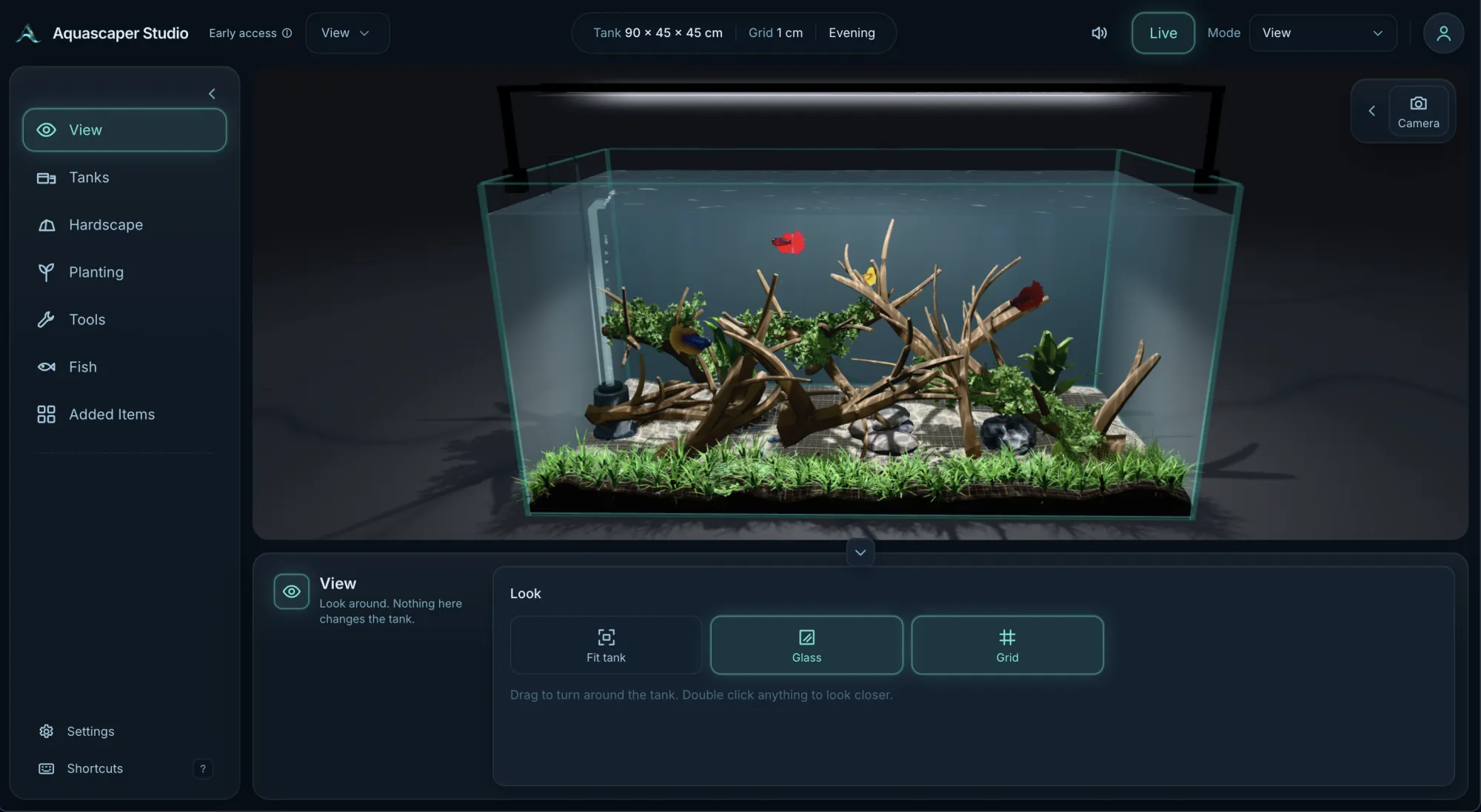
Get the rock work right before you dose it.
Lay out the rock and plan your first corals while the tank cycles with nothing in it but rock and flow.
Open the builder