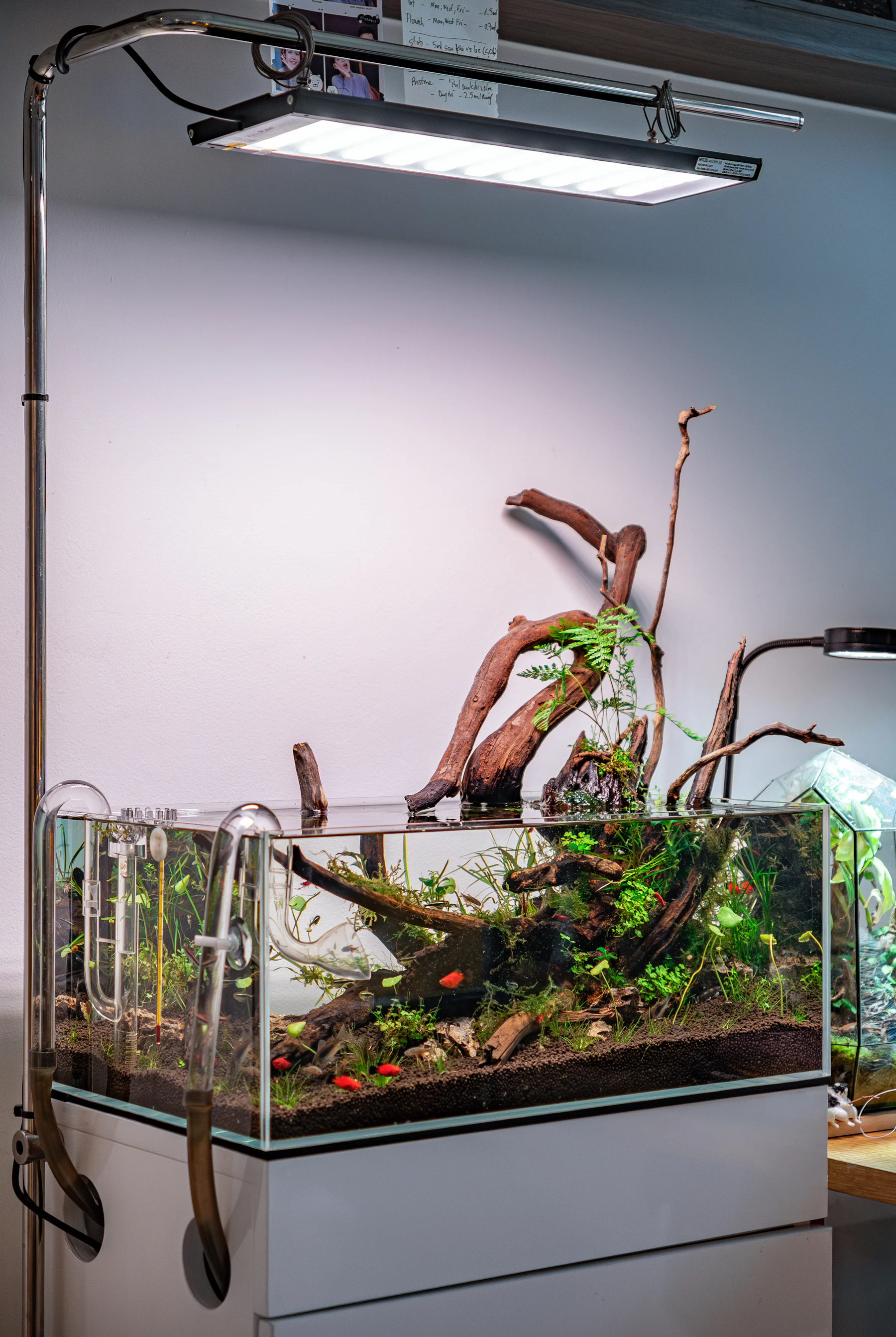
Understanding Aquascape Lighting
Aquarium lights sell watts, lumens, spectrum, and dramatic colours. Plants mainly care about usable light reaching their leaves, delivered consistently without excess.
Photo by Huy Phan on Unsplash
In this guide
- PAR is the number that matters most
- Low, medium, and high light are ranges
- Duration and intensity are different controls
- Spectrum matters, but not the way marketing suggests
- Spread is as important as peak power
- Light, CO₂, and nutrients form one system
- Algae is not proof that the light is bad
- LED, T5, and older technologies
- How to choose a light without owning a PAR meter
- A setup that is hard to regret
The brightest aquarium light is rarely the best aquarium light.
Plants need light for photosynthesis, but more light also raises their demand for CO₂ and nutrients and makes instability easier for algae to exploit. Good lighting is not maximum output. It is enough usable light, spread where the plants are, for a sensible number of hours.
PAR is the number that matters most
Aquarium lights are sold with watts, lumens, colour temperature, diode counts, and names involving words such as vivid, pro, and solar.
Plants remain unimpressed by the box.
For planted aquariums, the most useful measurement is PAR, photosynthetically active radiation. In practice you will usually see it reported as photosynthetic photon flux density in µmol/m²/s.
PAR tells you roughly how many photons in the photosynthetically useful wavelength range are reaching a surface each second.
The location of the measurement matters. A fixture producing strong PAR just below the water surface can deliver much less at the substrate of a deep aquarium. Water depth, mounting height, lenses, reflectors, hardscape, floating plants, and neighbouring stems all change what reaches a leaf.
This is why watts per litre is a weak rule for modern LEDs. Two fixtures drawing the same power can distribute very different amounts of useful light into the aquarium.
Lumens are designed around human visual sensitivity. They are useful for describing how bright a lamp looks to us, not how much photosynthetic light reaches a carpet plant.
If a manufacturer publishes a PAR map at several depths, that is far more useful than a large lumen number on the front of the box.
Low, medium, and high light are ranges
There is no universal border where medium light becomes high light, but practical planted-tank ranges are useful.
At substrate level, roughly:
Treat those as working bands, not laws.
Anubias, Java fern, Bucephalandra, mosses, and many Cryptocoryne are comfortable toward the lower end. Many common stems and carpets can grow well in the middle range, particularly with good CO₂. Demanding coloured stems and dense layouts can benefit from higher intensity.
The important correction is that carpeting plants do not automatically require brutal light. Adequate CO₂, nutrition, healthy planting, and reasonable PAR can produce a carpet without turning the aquarium into a tanning bed.
Higher light mainly buys faster growth and stronger potential colouration. It also buys faster consequences when something else is wrong.
Duration and intensity are different controls
A weak light left on for 12 hours is not equivalent to a strong light run for 6 hours, even if a crude multiplication suggests similar total energy.
Photosynthesis responds to intensity, plants reach physiological limits, and algae exposure changes with both intensity and duration. Treat the dimmer and timer as separate tools.
For a newly planted aquarium, a conservative photoperiod of around 5 to 6 hours per day is a sensible starting point. Tropica similarly recommends 6 hours per day during the first 2 to 3 weeks of a new planted setup before increasing gradually.
Once plants are rooted, growing strongly, and the aquarium is stable, extending toward 7 to 8 hours is reasonable for many systems. Some mature aquariums run longer successfully, but there is no requirement to imitate daylight outdoors.
Your living room is not a river basin. The aquarium is an artificial system with a very bright lamp sitting a few centimetres above it.
Use a timer. Consistency beats remembering to switch the light off after a film.
hours per day
If algae pressure rises after extending the photoperiod, return to the previous schedule before changing fertiliser, CO₂, flow, and livestock all at once.
Your living room is not a river basin.
Spectrum matters, but not the way marketing suggests
PAR counts photons across the traditional photosynthetically active range without telling you their colour.
Spectrum describes how a fixture distributes output across wavelengths.
Aquatic plants can use a broad range of visible light. Red and blue wavelengths are strongly involved in photosynthesis, while green light penetrates leaves and plant canopies better than its old reputation suggests. A balanced spectrum can grow plants perfectly well.
Spectrum also changes how the aquarium looks.
A fixture with carefully chosen red, green, and blue output can make red stems, green leaves, fish, and hardscape appear more distinct. Two lights with similar PAR can therefore produce very different-looking aquariums.
This is where personal taste is allowed to win.
Colour temperature in kelvin is mainly a description of the visual appearance of white light. A higher kelvin number does not automatically mean better plant growth, and a lamp labelled full spectrum is not automatically superior.
Choose spectrum for good plant performance and for a colour rendition you actually want to look at every evening.
Do not buy a light solely because its app can make the aquarium purple.
Spread is as important as peak power
- Plant to the map. Shade-tolerant species belong in the pockets the layout already makes.
- Height buys spread. Raising the fixture softens the hotspot and reaches the corners.
A PAR number measured at the centre of the substrate tells only part of the story.
A narrow fixture can create a bright central strip while front corners, back corners, and areas behind hardscape receive much less light. Tall stem plants then shade their own lower leaves, while a carpet near the front glass stretches toward the centre.
Look for PAR maps rather than a single centre measurement when possible.
Mounting a fixture higher generally improves spread and softens hotspots, although some intensity is lost. A wider fixture or two appropriately spaced light bars can produce more even coverage over a wide aquarium than one extremely powerful central source.
Hardscape changes the map too. A large stone can create a useful shaded pocket for Anubias. A dense branch structure can make the plants behind it struggle even though the fixture specification looks generous.
Design around those shadows rather than fighting all of them.
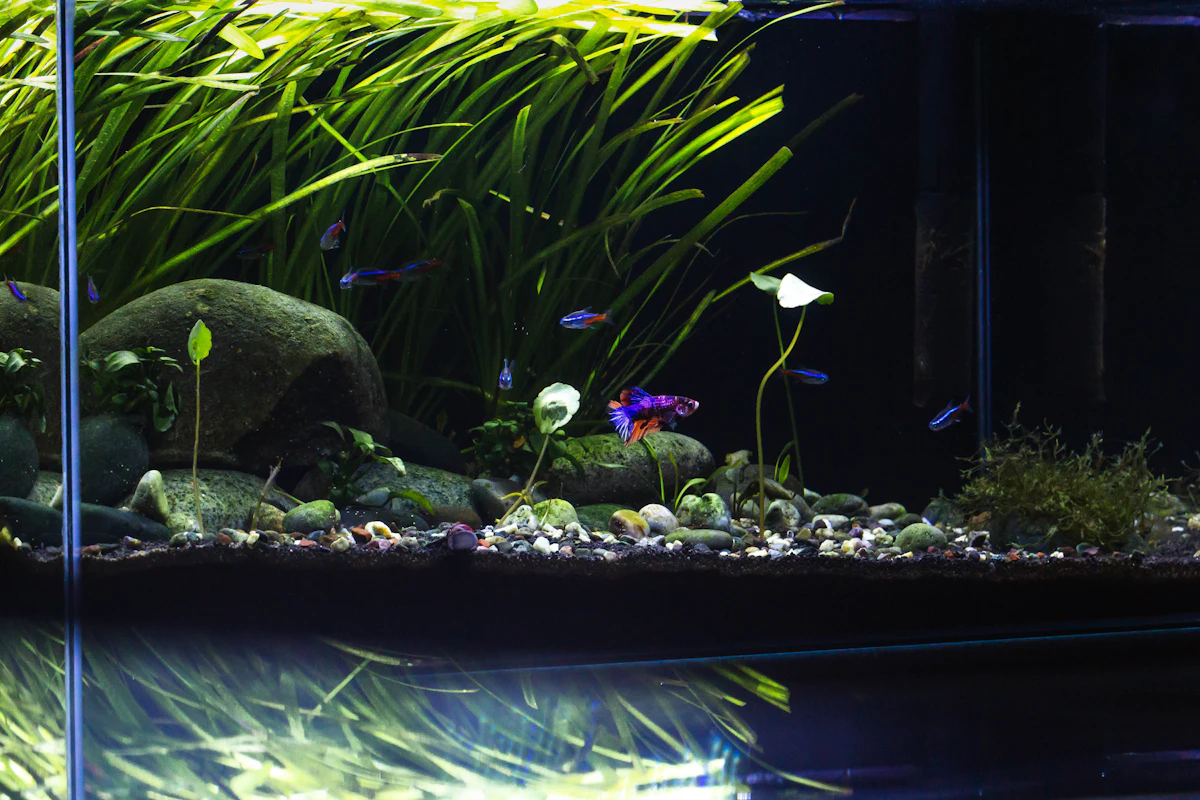
Put shade-tolerant species where the layout naturally shades. Put demanding stems where light actually reaches. This is cheaper than solving every dark corner with more wattage.
Light, CO₂, and nutrients form one system
Light controls how hard you ask plants to work.
Raise intensity and healthy plants can photosynthesise faster, but only if they can obtain enough carbon and nutrients to support that rate. If CO₂ delivery is inconsistent or a nutrient is limiting, more light does not repair the shortage.
It increases demand.
That is why high light is usually paired with pressurised CO₂ in demanding aquascapes. Around 90 µmol/m²/s and above at substrate level, the margin for sloppy carbon delivery and poor maintenance becomes noticeably smaller.
Low light is not inferior. It is a stability strategy.
A tank running around 20 to 40 µmol/m²/s with slower plants can be beautiful, require less pruning, tolerate missed maintenance better, and run without injected CO₂ depending on the plant selection.
Medium light with stable CO₂ is also an excellent combination. You gain faster, more flexible growth without needing to push the fixture anywhere near maximum output.
The expensive light you bought is allowed to run at 45%. It will cope emotionally.
Algae is not proof that the light is bad
Algae under a powerful fixture often gets blamed on spectrum.
Usually the more useful diagnosis is that the system is receiving more light than the plants can use consistently.
Check the causes in this order:
- Intensity is too high for the available CO₂ and plant mass.
- The photoperiod is longer than the aquarium currently needs.
- CO₂ delivery or circulation is unstable.
- Plants are unhealthy, newly transplanted, or heavily trimmed and temporarily consuming less.
- Maintenance has allowed organic debris and damaged growth to accumulate.
Spectrum can influence appearance and plant morphology, but changing from one respectable planted-tank LED to another rarely fixes a fundamental imbalance.
When algae appears after a lighting change, undo the lighting change first.
Do not respond to algae by cutting every nutrient to zero. Healthy plants need nutrients too, and starving them while keeping the same strong light is a peculiar way to help them compete.
LED, T5, and older technologies
Modern planted aquariums are dominated by LED fixtures for good reasons: efficiency, low heat into the room, dimming, compact size, controllable spectrum, and easy timers.
T5 fluorescent fixtures can still grow plants extremely well. Their broad, even spread is excellent, especially over wide tanks. They are simply less convenient, less efficient, and increasingly awkward to source compared with good LEDs.
Metal halide and other high-intensity discharge lamps can produce beautiful shimmer and substantial output, but heat, power use, bulb replacement, and limited control make them difficult to justify for most new freshwater builds.
Do not replace a functioning T5 setup because the internet has decided it is old.
If buying new, a dimmable LED with published PAR data, good spread, a reliable timer, and a spectrum you like is the practical choice.
The dimmer matters more than a long list of animated sunrise effects.
How to choose a light without owning a PAR meter
PAR meters are useful and expensive. You do not need to own one to make a sensible purchase.
Start with aquarium dimensions, especially water depth. Then define the plants you genuinely plan to grow.
Look for independent PAR measurements or manufacturer PAR maps taken at a depth similar to your aquarium. Pay attention to edge readings, not just the centre.
If no PAR data exists, find established aquariums using the same fixture over a similar tank depth. A successful example is not laboratory data, but it is more useful than guessing from watts.
Prefer a fixture with more maximum output than you immediately need if it has reliable dimming. Running a capable light below maximum gives room to adjust later.
For a low-tech tank, aim for modest substrate PAR and good spread. For a mixed planted tank, the middle ranges are usually enough. For demanding high-tech stems, choose a fixture that can reach higher intensity evenly, then earn the right to turn it up by first stabilising CO₂ and maintenance.
Do not buy for a hypothetical future Dutch tank if you currently want six Cryptocoryne and a piece of wood.
A setup that is hard to regret
For a new planted aquarium:
- Choose plants before choosing the final light setting.
- Find PAR data at approximately your aquarium depth where possible.
- Mount the fixture so it covers the whole planted footprint rather than creating one central hotspot.
- Begin around 5 to 6 hours per day on a timer.
- Start below the fixture's maximum intensity, especially with fresh aquasoil or newly transplanted plants.
- Keep CO₂, fertilisation, and maintenance consistent while plants establish.
- Watch new growth, lower-leaf health, stretching, colour, and algae rather than judging only by how bright the tank looks.
- If plants are healthy and you want faster or denser growth, raise intensity gradually.
- If algae increases after the change, return to the last stable setting and wait before changing anything else.
- Extend the photoperiod toward 7 to 8 hours only when the aquarium is established and there is a reason to do it.
Light should make the plants' job possible, not make your maintenance job compulsory.
Start lower than your ego suggests. Plants are quite willing to tell you when they need more.
See the shadows before you buy the light.
Lay out the hardscape and planting first, so you know which corners sit in shade and which take the brightest light.