How to Cycle a New Tank
A new filter has almost no useful bacterial capacity. Build that colony before livestock arrives, then prove it can process waste before stocking.
Photo by karl muscat on Unsplash
In this guide
- What you are actually growing
- Fishless cycling is the cleanest starting point
- Seeded media changes the timetable
- How to test the cycle
- Temperature, oxygen, pH, and chlorine matter
- Plants make the picture less tidy
- The mistakes that waste the most time
- What to do when the cycle is complete
- A workable sequence
A new aquarium can look finished while being biologically almost empty.
Clear water, a running filter, warm temperature, and planted substrate do not mean the tank can process fish waste. Cycling is the period in which you establish enough nitrifying microorganisms to turn toxic ammonia into nitrite and then into the much less toxic nitrate.
What you are actually growing
Fish release ammonia through their gills and from decomposing waste. Uneaten food, dead leaves, and anything else organic eventually contributes more.
The filter does not remove that ammonia by magic. Its useful biological job is providing oxygenated surface area where nitrifying microorganisms can live. One group oxidises ammonia to nitrite. Another oxidises nitrite to nitrate.
That population grows to match the food available to it. A tank that has processed a small ammonia load is prepared for a small load, not an instant crowd of fish.
This is why leaving an empty aquarium running for four weeks is not cycling it. Time is not the ingredient. An ammonia source is.
The organisms also live mainly on surfaces rather than floating around waiting in the water. Filter media, substrate, rock, wood, glass, and plant surfaces all contribute. Replacing most of the water does not reset a mature cycle. Sterilising or replacing established filter media can.
Time is not the ingredient. An ammonia source is.
Fishless cycling is the cleanest starting point
The most controllable method is fishless cycling with a measured ammonia source.
Use an aquarium product intended for fishless cycling, or another ammonia source whose concentration and ingredients you can verify. Do not improvise with household cleaner that contains fragrance, surfactants, detergent, or other additives.
A practical starting target is around 2 mg/L of ammonia nitrogen, following the dosing instructions for the specific product. Commercial fishless-cycling methods commonly use roughly this load because it is enough to build useful bacterial capacity without deliberately driving ammonia and nitrite to extreme concentrations.
More is not faster. Very high ammonia or nitrite can inhibit the organisms you are trying to grow. If either climbs unexpectedly high, stop adding ammonia and use a water change to bring the concentration down.
Then wait and measure.
At first, ammonia stays high because very little can process it. Later ammonia begins to fall and nitrite appears. Eventually nitrite also falls and nitrate accumulates.
The graph is not always tidy. Plants can consume nitrogen, test kits have limited resolution, seeded media can compress the whole process, and different tanks develop at different rates. Follow the measurements rather than expecting a particular spike on a particular Tuesday.
Seeded media changes the timetable
The fastest safe shortcut is not a bottle. It is mature biological media from a healthy established aquarium.
A used sponge, ceramic media, or other established filter material already carries the organisms you are trying to cultivate. Move it wet, keep it oxygenated, and put it into the new filter promptly.
The qualification matters: only seed from a tank whose health you trust. Along with useful bacteria, wet media can move snails, algae, parasites, and pathogens.
Bottled nitrifying bacteria can also shorten a cycle. Some products have careful storage requirements and established use. Others make very ambitious promises from a bottle that has spent an unknown amount of time on a warm warehouse shelf.
Use bottled bacteria as an inoculum, not as permission to stop testing.
A genuinely seeded tank may become ready quickly. An unseeded tank can take several weeks. The calendar does not decide when either tank is finished.
Nothing but water, media and a dosed ammonia source
Mature media from a tank whose health you trust
How to test the cycle
You need tests for ammonia and nitrite. Nitrate is useful because its appearance helps show where nitrogen is going, but ammonia and nitrite are the important readiness tests.
Test consistently and record the results. A note on your phone is enough.
Do not keep adding a full ammonia dose every day simply because ammonia has fallen. That can create unnecessarily high nitrite and nitrate. Feed the developing colony according to the cycling method you are following, and wait for both stages of nitrification to catch up.
The useful final test is a challenge dose.
When ammonia and nitrite have already fallen to effectively zero, add the same measured ammonia load used for the cycle, around 2 mg/L ammonia nitrogen if that is the method and product you chose. Test again about 24 hours later.
If ammonia and nitrite have both returned to effectively zero, the biofilter has demonstrated that it can process that load in a day.
That is considerably more useful evidence than saying the aquarium has been running for a month.
- 01DoseAdd the same measured ammonia load you cycled with, around 2 mg/L ammonia nitrogen.
- 02Wait 24 hoursLeave the filter running and change nothing else.
- 03Test bothAmmonia and nitrite together, not ammonia alone.
The biofilter processed a full load in a day. Change enough water to drop the accumulated nitrate, then start stocking gradually.
Not finished. Keep feeding the colony on the schedule your method uses, and check pH, carbonate hardness and flow before assuming the bacteria are at fault.
Test-kit units deserve attention here. Some products report ammonia as nitrogen, while others report total ammonia. Follow the scale and instructions for the kit and ammonia product you actually own rather than converting numbers casually between systems.
Temperature, oxygen, pH, and chlorine matter
Nitrification is biological work, so the environment around the filter matters.
Keep the filter running continuously. Nitrifying organisms need oxygen, and stagnant filter media is not useful filter media.
Always dechlorinate tap water before it reaches established biological media. Chlorine and chloramine exist specifically to control microorganisms in drinking water. Asking them to spare the organisms in your filter would be optimistic.
Avoid extreme pH during cycling. Nitrification slows as water becomes strongly acidic, and a cycle can appear to stall after alkalinity is consumed and pH falls. If ammonia stops moving for days, check pH and carbonate hardness before buying another bottle of bacteria.
Warm water generally speeds biological activity, but there is no need to cook the aquarium. If the tank will be heated for its eventual livestock, running it at a normal tropical temperature is sufficient.
Good surface agitation is more important than squeezing another degree from the heater.
Plants make the picture less tidy
A heavily planted aquarium does not behave exactly like an empty glass box with a sponge filter.
Actively growing plants can take up ammonium and nitrate directly. Fast-growing stems and floating plants can remove a surprising amount of nitrogen before a test kit sees it. Aquasoils can also release ammonia during their early weeks.
That does not make cycling irrelevant. It means the nitrogen has more destinations.
In a densely planted tank, judge readiness from the whole system: established plant growth, stable water parameters, a functioning filter, and the ability to process a controlled ammonia challenge where appropriate.
Some aquascapers plant heavily from day one, perform frequent early water changes, and add livestock gradually once the tank settles. That can work very well. It is not the same as dropping a full fish load into a fresh aquarium because the plants look healthy.
Plants provide buffer. They do not issue immunity certificates.
The mistakes that waste the most time
The common failures are fairly repetitive.
- Running an empty tank with no ammonia source. A filter spinning water around does not create a useful bacterial population by itself.
- Adding ammonia aggressively whenever a test reaches zero. Excess does not accelerate the second half of the cycle and can make interpretation harder.
- Cleaning filter media under untreated tap water. Rinse established media gently in removed aquarium water or appropriately dechlorinated water when it actually needs cleaning.
- Replacing all biological media at once. Manufacturers like replacement schedules because replacement media is a product. Your bacteria are less enthusiastic.
- Trusting a fixed number of days. A cycle is finished when the system demonstrates processing capacity, not when a countdown reaches zero.
- Adding the entire planned fish population immediately. The colony adapts to load. Give it a load it can follow.
There is also no prize for producing the highest nitrate reading. Nitrate confirms processing, but accumulating a huge amount only creates a larger water change before livestock arrives.
What to do when the cycle is complete

Once the aquarium passes its ammonia challenge, reduce accumulated nitrate with a substantial water change. Match temperature reasonably, use dechlorinator correctly, and avoid disturbing the filter unnecessarily.
Then stock gradually.
The exact pace depends on aquarium size, fish size, feeding, planting, and how strongly you challenged the filter. A small group followed by testing is safer than filling every planned stocking slot on the first afternoon.
For the first couple of weeks after adding livestock, keep ammonia and nitrite tests nearby. Test after significant stocking changes and whenever fish behaviour looks wrong.
If either becomes detectable, stop adding livestock, feed conservatively, check that filtration is running, and use water changes to protect the animals while the biofilter catches up.
If you finish cycling but cannot buy fish immediately, keep the biofilter supplied with a modest ammonia source rather than leaving it unfed for an extended period. You do not need to recreate the entire cycle every day.
A workable sequence
If the aquarium is empty today:
- Set up the tank, dechlorinate the water, and run the filter continuously.
- Add plants now if they are part of the plan.
- Add a known ammonia source according to its instructions, using around 2 mg/L ammonia nitrogen as the working challenge for a standard fishless method.
- Add trusted mature media or a reputable bacterial starter if you have it.
- Test ammonia and nitrite regularly. Record the results.
- Redose according to the cycling method rather than automatically adding a full dose every day.
- When both ammonia and nitrite have fallen to effectively zero, perform a final measured ammonia challenge.
- Confirm that both are effectively zero again about 24 hours later.
- Change enough water to reduce accumulated nitrate before livestock arrives.
- Add the first livestock gradually and keep testing after each meaningful increase in bioload.
If fish are already in an uncycled aquarium, do not deliberately add ammonia. You are managing a fish-in cycle. Protect the animals with testing, restrained feeding, appropriate water changes, dechlorination, and stable filtration while the colony develops.
Cycling is mostly waiting while microorganisms do unpaid infrastructure work.
Give them the food, oxygen, and surfaces they need. Then make them pass the test before the fish move in.
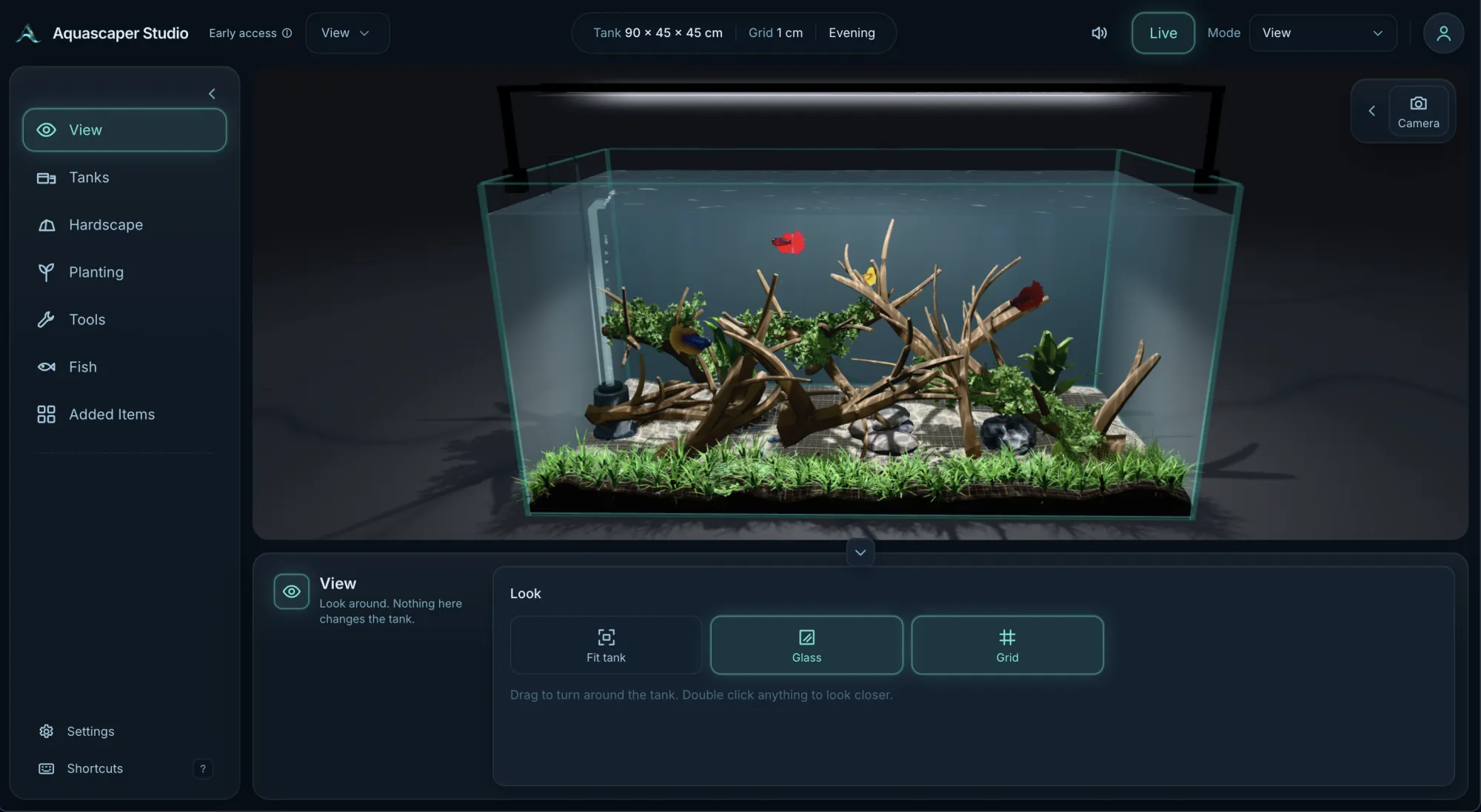
Set the tank up on screen first.
Cycling is weeks of waiting. Use them to settle the hardscape and planting, so nothing needs moving once the water is in.
Open the builder