The Nitrogen Cycle Explained
Ammonia to nitrite to nitrate. The nitrogen cycle is the single most important thing a new aquarist can learn. Without it, no tank is safe for fish.
Photo by Huy Phan on Unsplash
In this guide
Almost every dead fish in a beginner's tank comes down to one thing: the tank was not ready. Not the wrong food, not bad luck at the shop. The filter had no bacteria in it, and the fish were slowly poisoned by their own waste.
This is the part of the hobby nobody sells you. There is no product on the shelf that looks like "biology." But if you understand what follows, you have already avoided the mistake that kills most first tanks.
What is actually happening
Fish excrete ammonia. Continuously, through their gills, not just as solid waste. Uneaten food rots into ammonia. Dead plant leaves, a snail you did not notice had died, the last two flakes that drifted behind the driftwood: all ammonia.
Ammonia is lethal to fish at concentrations you cannot see, smell, or guess at.
In a healthy tank, two groups of bacteria handle it:
- Ammonia oxidisers convert ammonia (NH₃) into nitrite (NO₂⁻).
- Nitrite oxidisers convert nitrite into nitrate (NO₃⁻).
Nitrate is the end of the line for most home aquariums. It is far less toxic, and you remove it with water changes or feed it to plants.
That is the whole cycle. Waste in, three chemical steps, and the tank stays alive.
Fish, uneaten food, decaying leaves
- NH₃AmmoniaDamages gills at trace levelsAmmonia oxidisers
- NO₂⁻NitriteBlocks oxygen transport in the bloodNitrospira, the nitrite oxidisers
- NO₃⁻NitrateFar less toxic, removed by water changes
Exported by water changes, or taken up by plants
The part most guides get wrong
Older books credit Nitrobacter with the nitrite step. Research on actual aquarium filters found Nitrospira is the dominant organism in freshwater tanks, not Nitrobacter. It does not change what you do, but it explains why some bottled bacteria products underperform: they were cultured against the wrong target.
It also matters for a more practical reason. These bacteria live on surfaces, not in the water. Filter sponge, ceramic media, substrate grains, the underside of driftwood. This is why you can change 50% of your water without hurting the cycle, and why rinsing your filter sponge under a hot chlorinated tap can wipe out weeks of progress in thirty seconds.
Why ammonia kills
Ammonia exists in water as two forms in equilibrium: free ammonia (NH₃) and ammonium (NH₄⁺). Free ammonia is the dangerous one. Ammonium is comparatively harmless.
What decides the ratio? pH and temperature.
At pH 6.5, almost all of it sits as ammonium. At pH 8.2 in a warm tank, a meaningful fraction is free ammonia. This is why the same test reading of 0.5 ppm total ammonia is an emergency in an African cichlid tank and a nuisance in a soft-water shrimp tank.
Free ammonia starts damaging gill tissue around 0.02 mg/L. Your standard hobby test kit does not distinguish between the two forms, so it reports total ammonia and leaves you to do the maths. In practice, treat any detectable ammonia in a stocked tank as something to act on today, not this weekend.
0.044 mg/L free ammonia
8.8% of the 0.5 ppm reading
Above 0.02 mg/L, where gill damage begins. Act today.
Nitrite has a different mechanism. It binds to haemoglobin and blocks oxygen transport, which is why affected fish gasp at the surface in water that is perfectly well oxygenated. The blood turns brown. Chloride ions compete with nitrite for uptake at the gills, which is the reason an emergency dose of plain aquarium salt buys you time during a nitrite spike. It does not fix the cycle, it just stops the fish suffocating while you fix it.
Cycling a tank, in plain terms
You want to grow that bacterial population before fish arrive. You do that by feeding it ammonia yourself.
Fishless cycling is the standard method. Add pure ammonia solution to around 2 ppm, keep the heater at 26 to 28°C, run the filter, and test daily. Ammonia will fall as nitrite rises. Then nitrite falls as nitrate rises. When you can add 2 ppm of ammonia and read zero ammonia and zero nitrite twenty four hours later, the tank is cycled.
Expect three to six weeks. People who report seven days either seeded their filter or misread a test.
View as table
| Week | Ammonia | Nitrite | Nitrate |
|---|---|---|---|
| 0 | 100% | 0% | 0% |
| 1 | 98% | 6% | 0% |
| 2 | 61% | 77% | 1% |
| 3 | 6% | 99% | 9% |
| 4 | 0% | 52% | 60% |
| 5 | 0% | 3% | 96% |
| 6 | 0% | 0% | 100% |
Three things that stall a cycle, in order of how often they actually happen:
- pH crashing below 6.5. The bacteria slow down badly and can stop. Soft water plus an active substrate plus no water changes is the usual recipe. Check your KH.
- No ammonia source. People "cycle" an empty tank with a filter and no food for a month and wonder why nothing happened. Bacteria need to eat.
- Chlorine or chloramine. Topping up from an untreated tap kills the colony you just grew.
Seeded cycling is faster and I would use it every time if I could. Take used filter media, a handful of substrate, or a mature sponge from an established tank and put it in the new filter. You are transplanting a living colony rather than growing one. This can cut the process to days. The catch is that you inherit whatever else was in that tank, including snails and pathogens, so only seed from a tank you would happily buy fish from.
Bottled bacteria varies enormously in quality. Some products genuinely contain live, refrigerated, correct-species cultures and work. Many are shelf-stable for two years at room temperature, which should tell you something. If you use one, still test. Do not stock fish on faith.
Nobody enjoys the four week wait. Everyone who skipped it wishes they had not.
After the tank is cycled
The cycle is not a milestone you pass once. It is a population that adjusts to the load you give it.
If you cycle for a light bioload and then add fifteen fish at once, the bacteria cannot multiply fast enough and you get a spike in an "already cycled" tank. Add stock gradually, a few fish at a time, with a week or two between additions. Test after each addition rather than assuming.

Nitrate accumulates. Water changes are how you export it. In a planted tank, plants take up a share of nitrogen directly, sometimes preferring ammonium before it ever reaches the filter, which is one reason heavily planted tanks are more forgiving of mistakes. They are not immune, they just have more buffer.
Some tanks develop anaerobic zones in deep substrate or live rock where denitrifying bacteria break nitrate down to nitrogen gas. This is the norm in reef tanks and less reliable in freshwater, so do not plan around it.
A short honest note on testing
Liquid test kits are more accurate than strips. Strips are fine as a yes-or-no screen and poor for numbers. Shake the nitrate reagent bottle far harder and longer than you think you need to, because the second bottle settles and under-reads if you do not.
Test at the same time of day. In a planted tank with CO₂, pH swings by a full point between lights-on and lights-off, and a reading taken at a different hour is not comparable to yesterday's.
What to actually do this week
If you are starting a tank tomorrow:
- Set it up, dechlorinate, heater on, filter running.
- Get an ammonia source and a liquid test kit for ammonia, nitrite, and nitrate.
- Dose to 2 ppm ammonia and write the date on a piece of tape on the tank.
- Test every day or two. Redose ammonia to 2 ppm whenever it hits zero.
- When ammonia and nitrite both clear 2 ppm within 24 hours, do a large water change and start stocking slowly.
If you already have fish in an uncycled tank, you are doing a fish-in cycle whether you meant to or not. Feed lightly, do daily water changes of 25 to 50%, use a dechlorinator that detoxifies ammonia, and do not add anything else until the numbers settle.
Nobody enjoys the four week wait. Everyone who skipped it wishes they had not.
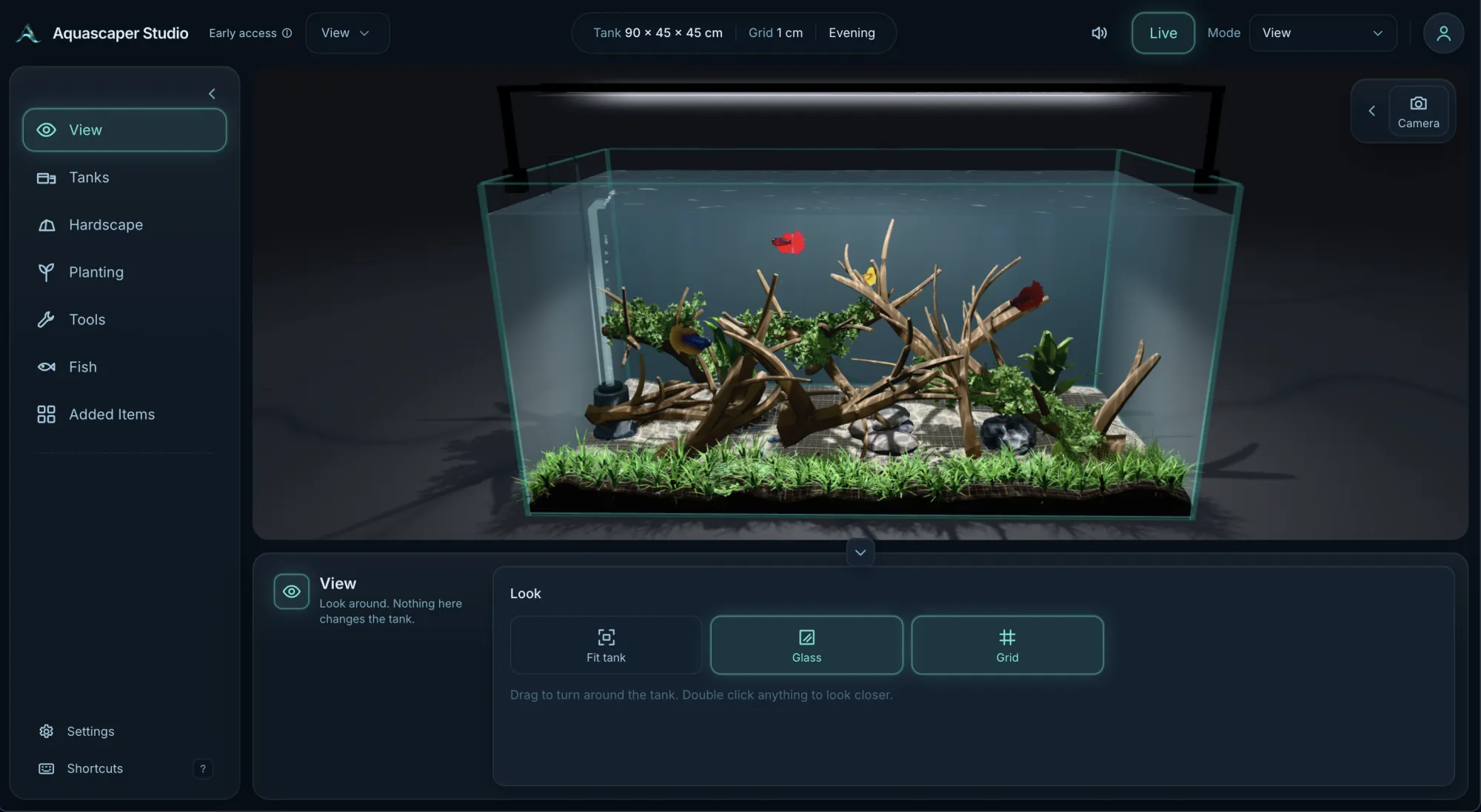
Plan the scape while the filter matures.
A cycle takes weeks. Spend them laying out the tank, so the day the numbers clear you already know where everything goes.
Open the builder